


Limitation of AOT
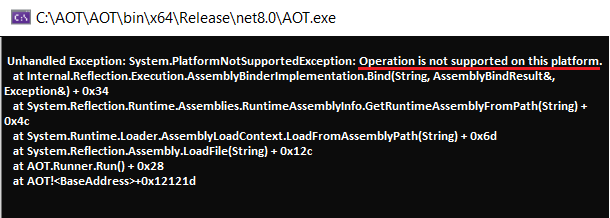
Ahead-of-Time (AOT) compilation is a smart way to make your software run faster. But, there are some catches you should know about, especially with .NET 8. If your code uses certain features like Assembly.LoadFile, System.Reflection.Emit, and a few others listed on the MSDN link, you won’t be able to use AOT compilation.
This is important to know if you’re making a platform that lets other developers add their own plugins or AddIns. AOT compiles everything your code needs to run on its own, so it doesn’t need the .NET framework to figure things out as it goes. That means you can’t just load extra parts of the program on the fly with Assembly.LoadFile, because AOT needs to know all the parts of the program ahead of time.
However, if you package everything your code needs into one big file (making it self-contained), you might end up using more memory than you need to because you’re loading the same things multiple times.
It’s also worth mentioning that just because you can’t load assemblies dynamically with AOT, it doesn’t mean you can’t use reflection. Reflection is still allowed and can be a clever way to get around some of the limitations of AOT compilation.
using System.Reflection;

namespace AOT
{
    public class Runner
    {
        public static void Run()
        {
            // Load the assembly
            Assembly loadedAssembly;
            try
            {
                loadedAssembly = Assembly.LoadFile(<<pat-to-dll-here>>);
            }
            catch (FileNotFoundException)
            {
                Console.WriteLine("Assembly not found.");
                return;
            }

            while (true)
            {
                Console.WriteLine("Enter method name to execute ('exit' or 'quit' to stop):");
                string methodName = Console.ReadLine();

                // Check for exit condition
                if (methodName.Equals("exit", StringComparison.OrdinalIgnoreCase) || methodName.Equals("quit", StringComparison.OrdinalIgnoreCase))
                {
                    break;
                }

                // Use reflection to invoke the method if it exists
                //Type type = typeof(ExecClass);
                Type execClassType = loadedAssembly.GetType("ExtraCommand.ExecClass");
                if (execClassType == null)
                {
                    Console.WriteLine("Class 'ExecClass' not found in the assembly.");
                    continue;
                }
                MethodInfo method = execClassType.GetMethod(methodName);
                if (method != null)
                {
                    try
                    {
                        object result = method.Invoke(null, null);
                        Console.WriteLine("Method executed successfully.");
                        if (result != null)
                        {
                            Console.WriteLine($"Result: {result}");
                        }
                    }
                    catch (Exception ex)
                    {
                        Console.WriteLine($"Error executing method: {ex.Message}");
                    }
                }
                else
                {
                    Console.WriteLine("Method not found.");
                }
            }
        }
    }


}
Lorem ipsum dolor sit amet, consectetur adipiscing elit. Ut elit tellus, luctus nec ullamcorper mattis, pulvinar dapibus leo.
namespace ExtraCommand
{
    public class ExecClass
    {
        public static void SayHello() => Console.WriteLine("Hello!");
        public static void SayGoodMorning() => Console.WriteLine("Good Morning!");
        public static void SayBye() => Console.WriteLine("Bye!");
    }
}
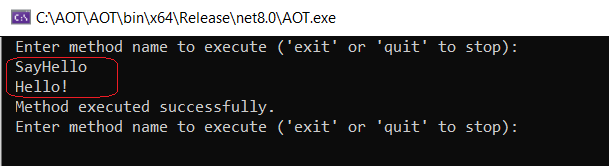
Execution without AOT option.
Execution with AOT
Workaround
In light of the constraints imposed by Ahead-of-Time (AOT) compilation, particularly the limitation on dynamically loading Add-ins, there exists a viable strategy to circumvent this challenge. Despite AOT’s restrictions, platforms can still enhance their functionality through the integration with remote services.
Imagine your platform as being capable of connecting to a service marketplace. Here, you can choose and subscribe to various services, each subscription potentially involving its unique requirements. Upon successful subscription, your platform initiates a connection to a REST API designed for setup purposes. This connection facilitates the download of specific configurations and, possibly, scripts (such as JavaScript) tailored for the plugin in question.
These configurations play a pivotal role in extending the platform’s user interface by incorporating elements like forms, dialogs, menus, and buttons, thereby enriching the user experience. Furthermore, given that AOT compilation does not preclude the use of reflection, executing scripts directly on the platform becomes feasible, allowing for the invocation of internal functions.
An exemplary tool in this context is Jint, an open-source JavaScript interpreter for .NET, which exemplifies how scripting can be seamlessly integrated within .NET applications. This approach mirrors the flexibility observed in creating Add-ins for applications like Google Docs or Sheets, where external functionality can be woven into the core platform, thus overcoming the limitations posed by AOT compilationI.
Conclusion
In summary, while Ahead-of-Time (AOT) compilation introduces certain limitations, particularly in dynamically loading additional components in .NET 8 environments, innovative strategies exist to navigate these constraints. By leveraging the potential of remote services and the judicious use of reflection, platforms can extend their functionalities without forsaking the performance gains of AOT. This blend of connectivity, scripting, and smart configuration exemplifies a forward-thinking approach to maintaining extensibility and enhancing user experiences within the bounds of AOT’s architectural considerations.
